
.png)

August 18, 2026
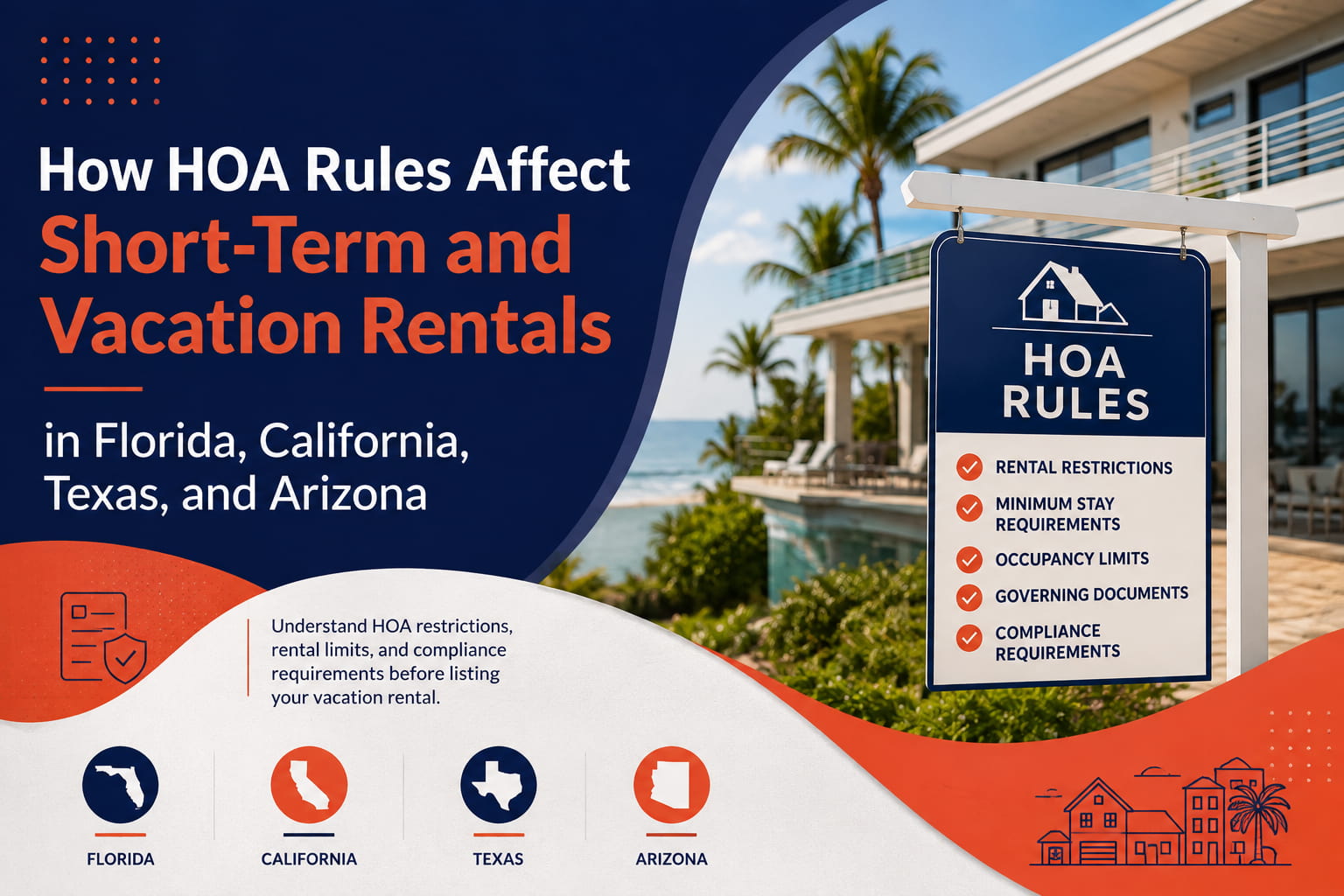
Thinking about turning your current or future property into a short-term or vacation rental? Before you list it on Airbnb, VRBO, or another rental platform, there's another set of rules you need to consider beyond city and state regulations: your homeowners association (HOA).
A property may be located in an area where short-term rentals are legal and still be prohibited by its HOA. This is why checking the HOA rules should be part of your due diligence before purchasing a vacation rental or applying for a short-term rental license.
Florida, California, Texas, and Arizona are all popular vacation rental markets, but HOA restrictions can vary significantly from one community to another. Here's what property owners should know before purchasing a vacation rental or turning a property into a short-term rental.
When determining whether a property can legally operate as a short-term rental, there is usually more than one set of rules to consider.
Depending on the property and location, you may need to review:
The important thing to remember is that obtaining a vacation rental license does not automatically override private HOA restrictions.
An HOA may prohibit short-term rentals altogether, require a minimum rental period, limit the number of rental properties in the community, or impose additional requirements on owners and guests.
Florida is one of the country's most popular vacation rental markets, making it an attractive location for property owners and investors.
However, state and local vacation rental requirements are only part of the equation. If the property is located within an HOA or condominium community, the association's governing documents may impose additional restrictions.
Before purchasing a Florida vacation rental, review the association's:
HOAs have unique options to establish minimum lease lengths (like 6-month minimums) or set annual limits on how many times a home can be leased. While these rules can take effect quickly across a community, they also provide complete clarity. Florida has tons of dedicated resort-style communities designed specifically for vacation rentals, so finding an STR-friendly HOA here is easier than almost anywhere else!
For more information about Florida's licensing requirements, see Vacation Rental License.
California’s massive tourism market makes it a dream spot for hosts, and state law actually gives existing property owners a huge advantage.
Under California Civil Code § 4740, if an HOA decides to pass a new rule restricting stays under 30 days, existing owners are protected. Unless you personally voted in favor of the new restriction, newly passed rental bans generally apply only to future buyers who purchase after the rule was enacted. If you already own a California community, you often hold a built-in green light to keep hosting!
The Orange County REALTORS® short-term rental resource provides examples of how local California rules can differ and highlights situations where homeowners may need to check with an HOA or condominium association.
The Lone Star State is a powerhouse for STR performance! Texas courts heavily favor property owners that hosting guests is a natural "residential use" of a home.
What does this mean for you? A Texas HOA can't stop you from hosting just by using vague language about "residential purpose". To restrict short-term stays, the HOA must have passed super specific, targeted rules like explicit “30-day minimum lease requirements” through a formal voting process. If those specific restrictions aren't in writing, you're usually in a fantastic position to host!
Before purchasing a Texas property for vacation rental use, review the governing documents for restrictions involving:
It's important not to confuse HOA restrictions with Texas landlord-tenant requirements. The Texas State Law Library's Landlord-Tenant Law guide provides helpful information about Texas rental laws.
The key is to determine whether the property satisfies both the applicable government requirements and the private restrictions attached to the property.
Arizona is known for being incredibly friendly to vacation rentals! State laws make it difficult for cities and towns to ban short-term stays, which opens up massive opportunities for hosts.
When it comes to HOAs, however, private communities set their own ground rules. The good news for buyers? Thanks to key legal rulings (like Kalway v. Calabria Ranch), Arizona HOAs can’t just invent surprising new bans on a whim, the restrictions must be explicitly spelled out in the neighborhood’s original covenants. If you’re shopping in Arizona, a quick check of the community’s written rules will give you total clarity on whether you’re good to launch.
If you're considering purchasing an Arizona investment property, working with local Arizona real estate brokers can also help you understand the property and its surrounding community.
If your HOA actively restricts short-term rentals but you still need your investment property to generate income, you have several options:
HOA restrictions can have a major impact on whether a property can operate as a short-term or vacation rental.
Florida, California, Texas, and Arizona all have strong vacation rental markets, but the rules can vary by state, city, county, and individual community. A property may qualify for a government-issued vacation rental license while still being subject to private HOA restrictions.
Before purchasing or listing a property, take the time to review all of the rules that apply.
If you're unsure whether a property qualifies, Vacation Rental License can help you understand the licensing and compliance requirements that may apply to your property.
The best time to discover an HOA restriction is before you buy, not after your first booking.


