
.png)

June 9, 2026
Managing short-term rentals is rewarding, but not all are long-term goldmines for property owners.
A short term rental is your asset, your income generating machine for a period of time. In due course of time, the market will change, regulations will stiffen and short term rental occupancy will also vary. In due course of time, many property owners change their vision and start asking themselves a question, "Is a Long Term Rental better for me? "
When is it smart to convert your short-term rental into a long-term rental? In order to make an informed decision about whether or not to convert your short-term rental into a long-term rental it is helpful to understand the fundamental changes that will occur in terms of how you will manage your rental, in terms of how your rental will generate income for you, and in terms of how your rental will be regulated by local governments.
With regards to the regulatory pressures facing short-term rentals, many cities have not only placed in place licensing requirements but have also placed caps on the amount of permits that can be granted out within a certain timeframe. Additionally, there are owner-occupied restrictions that are put in place to restrict how short-term rentals can be used by property owners. Last but not least, there are certain locations or zones within a city where short-term rentals are banned outright.
Research by the National Conference of State Legislatures outlines the widely varying laws throughout the country regarding short-term rentals, and how many states are continually imposing new restrictions each year. Even a property owner who currently complies with all laws and regulations in his or her state or local area can have their business banned overnight when laws change.
Additionally, the rules and regulations of short-term rental are subject to change on a frequent basis. It is common for short-term rental regulations to change so significantly within a couple of years, that what is compliant for a short-term rental at the time of a property purchase, can become non-compliant within a short period of time.
Thus, short-term rental as an investment property model typically requires a great deal of administrative complexity for owners, which can be off putting. Long-term rentals do not have to deal with the majority of these short-term rental complexities because leases for long-term rental fall under the laws of landlord-tenant, which do not change that often and are generally very straightforward to administer.
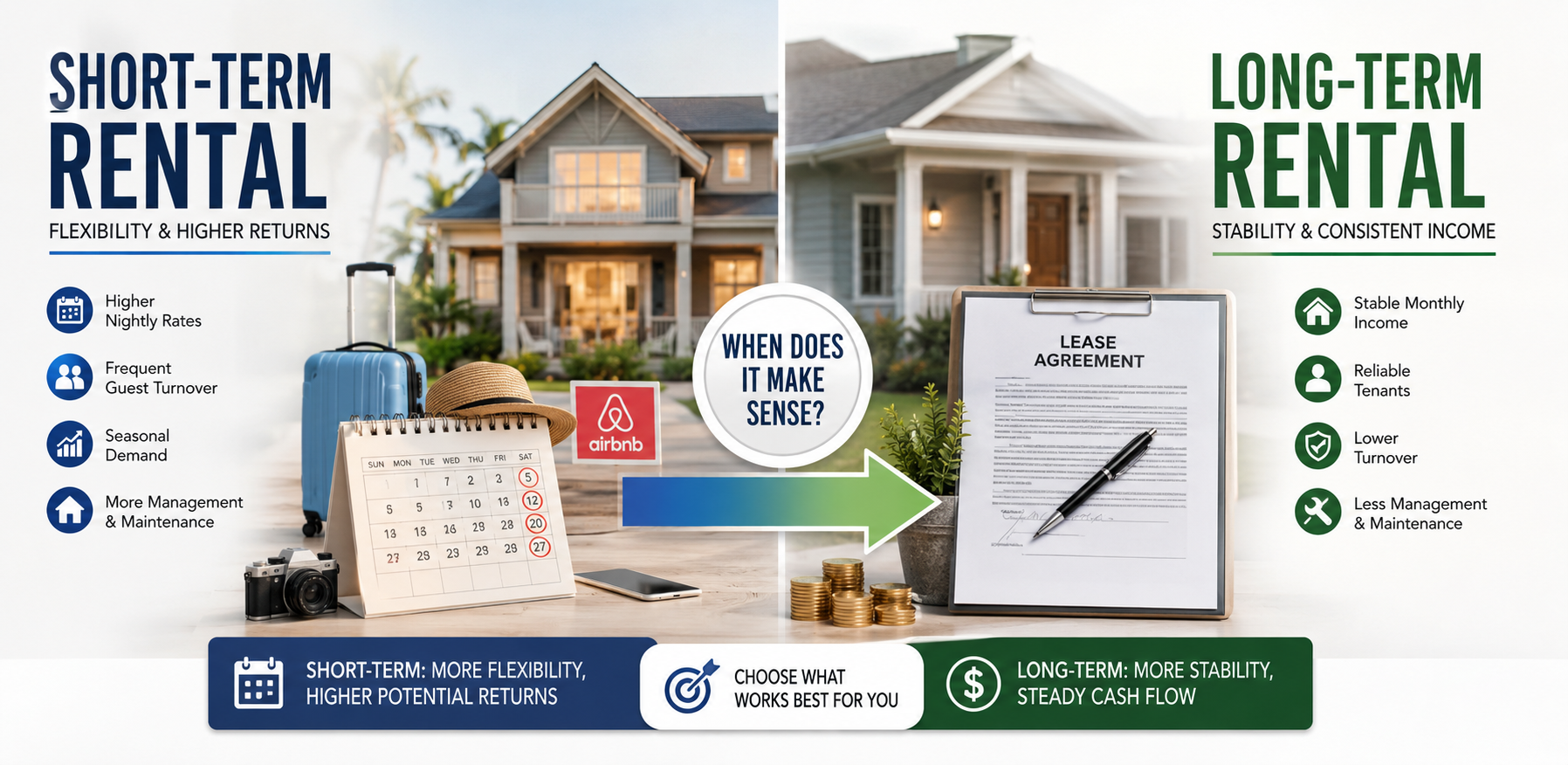
Short-term rentals can generate more money in peak season than long-term rentals, therefore are very attractive to investors. The key word however is 'peak'. And during shoulder and low season, short-term rentals can generate next to nothing at all.
Consider what eats into short-term rental income:
On the other hand, by renting out long term you gain the ability to collect a steady flow of predictable income and avoid losing large sums of money should market conditions take a sudden turn for the worse. Of course, there is usually a significant difference between long-term rent and the high season peak of a short-term rental, but you have to remember that when a short-term rental is vacant, you are not earning any money at all. Furthermore, after all the efforts put in, the profit margins are low and therefore not worth your time when you look at other forms of income-generating investments on the market.
The Urban Institute's work on housing through the Metropolitan Housing and Communities Policy Center produces rigorous research that examines long-term rental income. The Institute reports that long-term rental income tends to be correlated with local wage growth and/or housing demand and thus is more amenable to projection over multiple years than short-term rental income.
Short-term rentals on the other hand are very operationally intensive. The property manager will be responsible for guest communication, check-in /out, cleanings, re-stocking supplies, and performing repairs and maintenance in a timely fashion. This can be done with the assistance of a co-host or by utilizing a property management company that specializes in short-term rentals, but there are still many touchpoints with the guest.
Maintenance. Maintenance and repairs are a necessity of both renting strategies. However, because of the nature of both methods of rentals, the frequency and sense of urgency will vary. Short term vacation rentals can come and go with relatively short notice. When guests depart it can be a matter of hours or days prior to new guests checking in for their stay. In the case of long term renters this is less so, but not unheard of. In many ways, it's better to have guests who depart on a moment's notice fora period of time than for an extended amount of time. Short term renters can provide for surprise repair bills in the form of wear and tear between guests. This means that while there will certainly be maintenance for long term renters, it's far more likely to be predictable.
On the other hand, long-term rental properties have their own unique set of priorities to manage. These include tenant screening and approval, lease preparation and execution, timely collection of rent, periodic property inspections, and compliance with local and state landlord-tenant laws (see state landlord-tenant laws here).
There are, however, property management companies like Priority One Property Management that focus on long-term rentals. These companies handle all aspects of property management for the owner including tenant screening and placement, lease preparation and signing, maintenance and repairs, and regular property inspections.
A transactional relationship with guests is normal for short-term rentals. Because of that, owners and managers do not build a relationship with their guests. On the other hand, the relationships owners and managers build with their long-term renters can last as long as one year, two years or even more.
This changes how you approach the property. Tenant satisfaction directly affects lease renewals and vacancy rates. A well-maintained property with responsive management retains good tenants longer, which reduces the cost and disruption of turnover.
On the other hand, because a long-term rental tenant considers a property to be their home, it will be subject to less wear and tear between tenancies than a short-term rental property, which can expect to see an increase in wear and tear between each guest's tenancy.
Changing your strategy to short-term to long-term rentals can be a great option in the following situations.
The other hand, short-term rentals can be better for you than long-term in some ways, while long-term can be better in others. The bottom line is, there are a couple of factors to consider, and which model is better for you depends on them.


