
.png)

April 6, 2026
Sometimes yes. Sometimes no. And sometimes… yes, but only if you follow a very specific set of rules that feel like they were written on a Tuesday afternoon after three committee meetings.
If you are thinking about turning your primary residence into a vacation rental, you are not alone. It is one of the most common questions people ask right after realizing their home could generate income.
It sounds simple. You live there. You own it. Why not rent it out when you are not using it?
That logic makes sense. Cities do not always agree.
And this is where things get a little layered.
Early on, many homeowners start digging into regulations themselves. Some do fine. Others, especially in cities with stricter rules, end up consulting property managers just to understand how local laws actually apply in practice. Not because hosting is complicated, but because compliance tends to be.
Let’s take a closer look.
This part trips people up more than expected.
A primary residence is not just the place you feel most at home. It is usually defined by documentation:
Some cities go further. They may require you to live there for a minimum number of days per year. Often 180 days or more.
So if you are thinking, “Well, I stay there sometimes,” that might not qualify.
And if you move out later but keep renting it as a short-term rental… that is where compliance issues start creeping in.
You might expect cities to be more relaxed if you are renting your own home.
In some cases, they are.
Owner-occupied rentals are often seen as lower risk. Fewer party houses. More accountability. Someone is actually tied to the property.
But at the same time, cities are trying to manage housing supply. Short-term rentals reduce long-term housing availability, especially in high-demand areas.
So the rules become a balancing act.
Allow some flexibility. But not too much.
This is why regulations around short-term rental primary residence rules can feel inconsistent from one city to another.
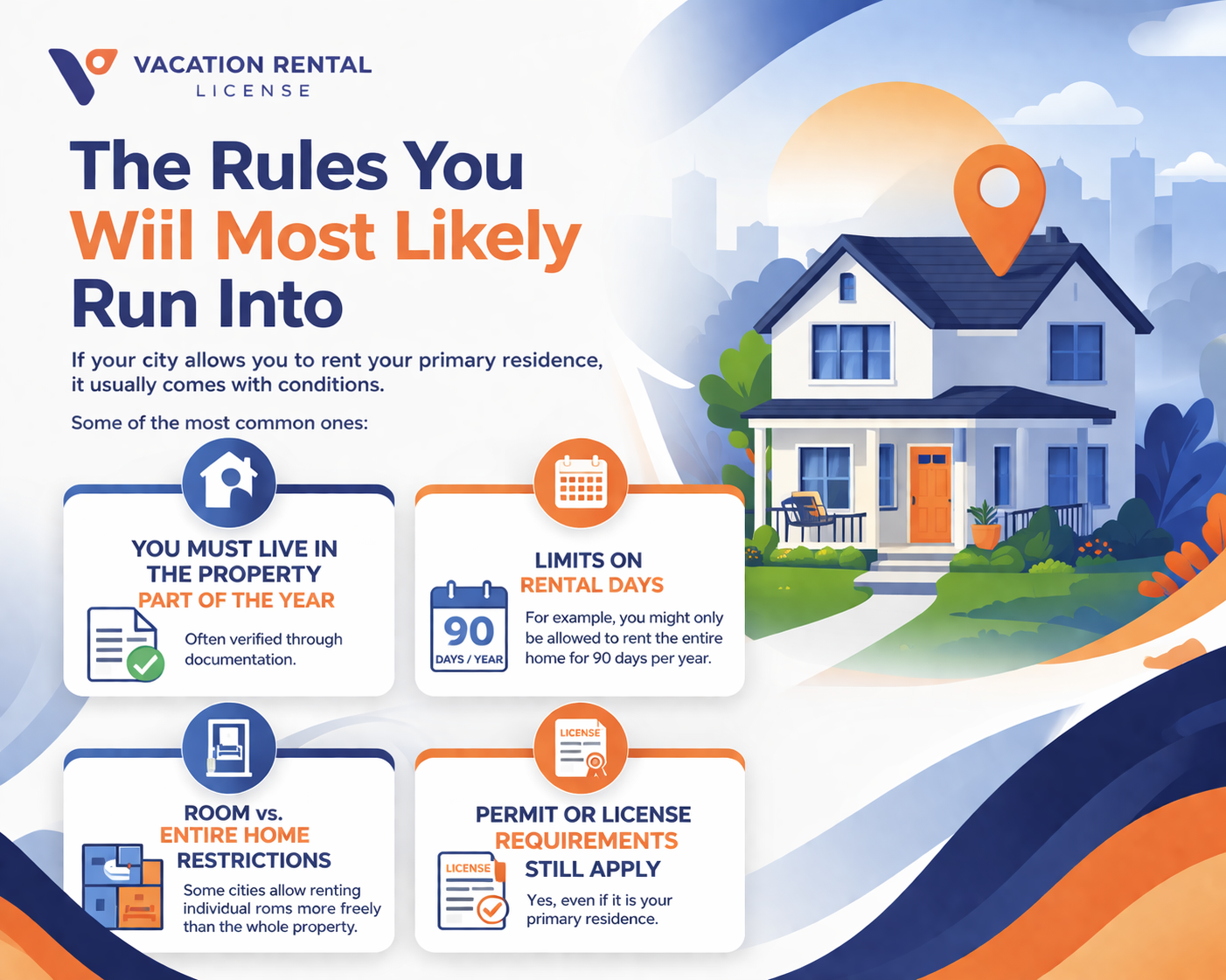
If your city allows you to rent your primary residence, it usually comes with conditions.
Some of the most common ones:
This is where people get caught off guard.
Living in the home does not exempt you from needing a vacation rental license. In most cases, you still need to go through the full approval process.
It is a very human reaction.
You own the home. You pay the mortgage. It feels like you should be able to use it however you want.
And to be fair, in many situations, that is true.
But when it comes to short-term rental compliance, local regulations take priority. Zoning laws, licensing requirements, and neighborhood rules all come into play.
This is similar to what happens when homeowners unintentionally become landlords. The transition sounds simple, but the responsibilities shift quickly. Situations like this are explored in more detail through resources about accidental landlords navigating rental decisions, which often highlight how quickly expectations change once a property becomes income-generating.
The same principle applies here. Once your home becomes a rental, even part-time, it enters a regulated space.
Zoning is one of the less obvious barriers.
Some residential zones restrict or prohibit short-term rentals altogether. Others allow them only under specific conditions.
You could have:
And still run into issues if zoning rules are not aligned.
It does not happen everywhere. But when it does, it tends to come as a surprise.
This is where things tend to unravel a bit. Not dramatically. Just gradually.
None of these mistakes are unusual. They are just easy to make.
Sometimes nothing happens right away. And that is part of the problem.
You might operate for months without issues. Bookings come in. Guests leave good reviews. Everything feels smooth. Then a complaint happens. Or a city audit. Or a new enforcement wave. And suddenly, the rules matter.
Violations related to vacation rental license requirements or zoning can lead to:
Not always. But often enough that it is worth paying attention early.
At some point, many homeowners realize that managing bookings is the easy part.
Staying aligned with regulations is the part that requires consistency.
This is where property managers often come into the picture. Not as a necessity for everyone, but as a way to handle the ongoing details. Permits. Renewals. Local rule changes. Documentation.
It is less about outsourcing control and more about reducing friction.
Especially in cities where rules evolve frequently.
Yes. In many places, you can legally turn your primary residence into a vacation rental.
But it is rarely as simple as listing it online and seeing what happens.
It depends on:
There is no universal answer. Only a series of conditions that need to line up.
Instead of asking, “Am I allowed to do this?” A better question might be: “What does my city require for me to do this properly?” That shift changes things. It moves you from guessing to verifying. And it usually prevents problems later.
If you are working through vacation rental licensing, primary residence rules, or compliance questions,Vacation Rental License helps property owners navigate the process from start to finish.
Sometimes having someone handle the regulatory side means you can focus on everything else. Like actually hosting.
In many cities, yes, but you must follow short-term rental primary residence rules, including permits, occupancy limits, and zoning requirements.
Usually, yes. Most cities require a vacation rental license even for owner-occupied properties.
A primary residence is where you live most of the year. Investment properties are not owner-occupied and often face stricter short-term rental regulations.
Yes. Many cities limit the number of days you can rent your home as a vacation rental each year.
You may face fines, suspension, or loss of your vacation rental license depending on the severity of the violation.


